
SubOcean Dissolved Methane Analyzer
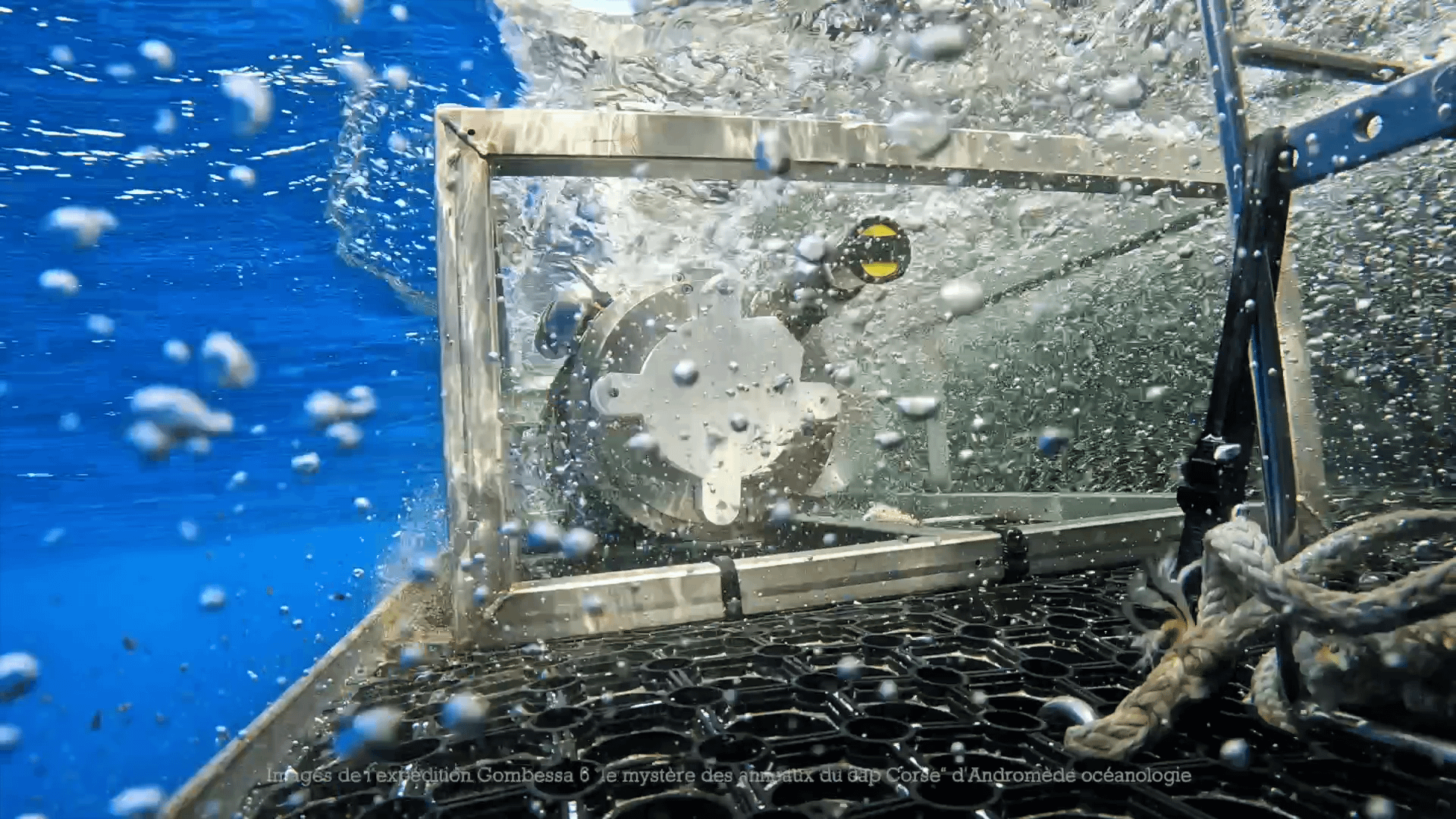
SubOcean is a field-deployable dissolved methane sensor for fast, high-accuracy measurement in marine and lacustrine environments, with in situ carbon isotopy to tell thermogenic sources from biogenic ones.
Fast, precise, field-ready
| Methane | 0 – 1,000 ppm (1.4 µM), detection limit down to 0.03 ppm (0.05 nM) |
|---|---|
| Ethane | 0 – 400 ppm (0.7 µM), detection limit 0.1 ppm (0.2 nM) — for source attribution alongside methane |
| Isotopy | In situ δ13C-CH4, accuracy ± 6‰ at 5 °C (CH4 range 2 – 1,000 ppm) |
| Accuracy | ± 5% on CH4 and C2H6 |
| Response time | 30 seconds |
| Measurement frequency | 1 Hz |
| Depth rating | 1,000 m |
| Water temperature | −2 to 35 °C |
| Operation | Standalone / remote, 10 hours battery autonomy |
| Dimensions | L 900 mm · ø 190 mm — 3 kg in water, 27 kg in air |
CH4 + N2O configuration available on request.
Get in touch
for the full datasheet.


Membrane Inlet Laser Spectrometry
Built on Membrane Inlet Laser Spectrometry (MILS), SubOcean combines membrane gas extraction with laser spectroscopy for fast in situ detection. A membrane continuously extracts dissolved gas from the surrounding water, and a laser spectrometer then analyzes it directly, without bringing water samples to the surface.
SubOcean was developed by A2 Photonic Sensors in collaboration with Roberto Grilli and the Institute of Environmental Geosciences (IGE), and has been proven across a wide range of field campaigns — see below.

Field-tested across the world’s waters
From Mediterranean seafloor to deep African lakes and Arctic waters, SubOcean has been deployed on scientific campaigns spanning marine and lacustrine environments. Below is a selection of documented deployments:
Cap Corse, Mediterranean Sea — Gombessa expedition (2023)
SubOcean joined a multidisciplinary expedition led by Laurent Ballesta and Andromède Océanologie to investigate the mysterious methane-linked seafloor rings off Cap Corse, delivering fast, high-resolution dissolved methane data in the field.
Read the full story →Western Black Sea — Envri Methane Cruise (2019)
Aboard the R/V Mare Nigrum, SubOcean mapped dissolved methane at two seafloor seep sites (~55 m and ~120 m depth) in the Romanian sector, as part of a multi-technique inter-comparison against a commercial sensor and discrete gas-chromatography sampling.
Grilli et al., Frontiers in Earth Science, 2021 →Lake Kivu, Rwanda
An extended-range SubOcean delivered the first continuous, high-resolution dissolved methane profile of Lake Kivu, covering the top 150 m of the water column in around 25 minutes.
Grilli et al., Geoscientific Instrumentation, Methods and Data Systems, 2020 →EPFL SENSE laboratory — ongoing expedition program
EPFL’s SENSE lab operates SubOcean across a growing set of expeditions: tracking methane release from subglacial waters in Western Greenland (2023–2025), and profiling Lake Geneva, Lake Cadagno and Lake Zug in Switzerland.
See the SENSE expedition program →Beyond these documented studies, SubOcean has also been used in many other locations, including the Sea of Japan, Lac d’Aiguebelette (France) and the Norwegian Sea (LoVe cruise, Lofoten-Vesterålen observatory).
Get the full specifications
Download the SubOcean datasheet for the complete set of specifications, or get in touch to discuss purchase, rental, or a configuration for another dissolved gas.
Download datasheet (pdf) contact us