
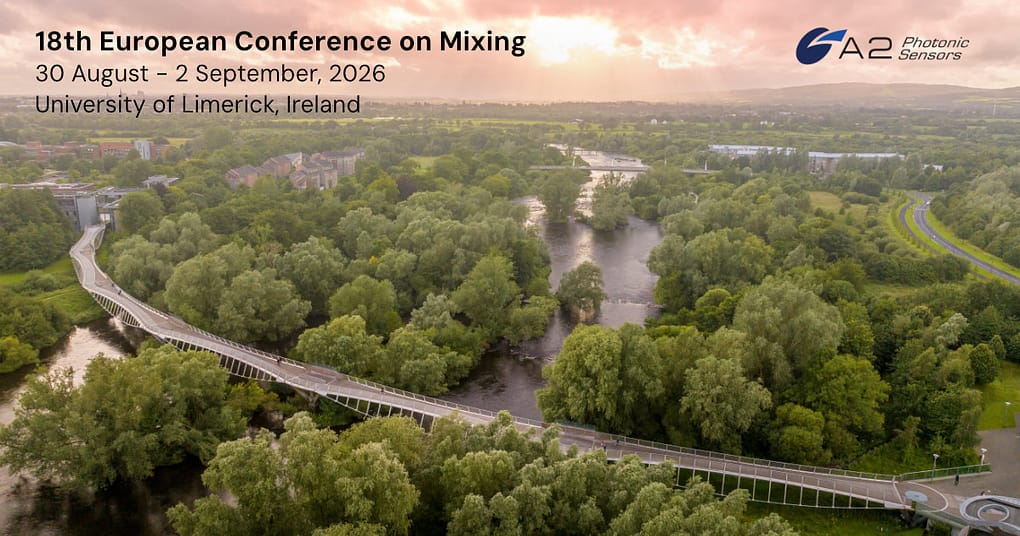
From 30 August to 2 September 2026, A2 Photonic Sensors will be at MIXING18, the 18th European Conference on Mixing, where our team will present our approach to local bubble measurement in gas-liquid mixing systems. This triennial conference — hosted this year by the University of Limerick and organised in collaboration with the EFCE Working Party on Mixing — gathers the European mixing community, academic and industrial, around the science and engineering of mixing across chemical, pharmaceutical, food, biotech, and energy processes. This edition’s theme, “Smarter Mixing,” puts digitalisation, cleaner processes, and future-ready industrial solutions at the centre of the discussion.
Local Bubble Measurements in Stirred Tanks and Bubble Columns
A stirred tank can hit its target mixing time, its target power draw, its target gas hold-up — and still hide very different local realities depending on where you look. Bubble size, bubble concentration, and local velocity can vary substantially from one region of a vessel to another, and these local variations often drive interfacial area, mass transfer, and gas dispersion more directly than any single averaged parameter.
Our M2 Bubble Analyzer, based on a Doppler optical probe, is built to answer that kind of question. The probe detects individual bubbles as they become impaled on its sensing tip, delivering local, continuous readings of bubble size, velocity, and gas hold-up — without requiring optical access through the vessel wall. That makes it a practical option in dense dispersions, opaque fluids, or geometries where other technologies such as PIV and PDA/PDPA struggle to get a clean line of sight.
Bubble Dynamics and Scale-Up: From Lab to Production
Bubble populations rarely scale the way global operating parameters do. A condition that looks equivalent on paper — same power input, same gas flow rate — can produce noticeably different bubble size distributions and gas circulation patterns once vessel geometry or impeller design changes. Local, spatially resolved measurements give researchers a way to track that evolution directly, rather than inferring it from averaged outputs, and to build the experimental datasets needed to validate multiphase CFD models against something more granular than a single global figure.
Talk to Us in Limerick
If you’re working on gas dispersion, bubble column hydrodynamics, impeller or sparger design, or scale-up validation, stop by and tell us what you’re trying to measure. We’re always keen to hear where existing tools fall short — it’s usually where the interesting problems are.